
Anyone who is dealing with Push-to-Talk over Cellular for the first time will quickly come across terms like PoC, PTT, 4G, 5G, MCPTT, IS440.1 or IS440.2.
The entry is actually surprisingly simple:
For Mobile Tornado, you only need a smartphone to start.
It can be your existing smartphone. It can be a newly purchased Android or Apple device. Or you can use a device designed specifically for Push-to-Talk, such as the IS440.RG, IS440.2, or IS440.1.
The communication platform remains the same.
You choose the device suitable for your workplace.
What is Mobile Tornado anyway?
Mobile Tornado is a Push-to-Talk-over-Cellular solution, short PoC.
The operating principle is similar to a classic walkie-talkie: press the button, speak, release the button.
The essential difference lies in the transmission method.
A classic walkie-talkie communicates via radio frequencies and – depending on the system used – directly with other devices or through its own radio infrastructure.
Mobile Tornado uses IP networks such as cellular and Wi-Fi. The application is device-independent and can be used on Android and iOS smartphones. Mobile Tornado explicitly states that existing smartphones can be used and the app can be installed via the respective app store.
This removes one of the biggest entry barriers:
You do not have to buy special radios first to try out Push-to-Talk.
An existing smartphone is sufficient to get started.
Let’s take a simple example.
A company has five service technicians, two employees in the warehouse, and one person in charge in the office.
All already own smartphones.
Mobile Tornado can create a common Push-to-Talk group from this. The employee in the office can talk to the service technician on the go just as easily as with the colleague in the warehouse.
The spatial range is not determined by the typical range of a local radio device. What matters is whether the respective device has a suitable data connection via cellular or Wi-Fi. Mobile Tornado supports different cellular and Wi-Fi networks.
And this is exactly where one of the great strengths of PoC lies:
Communication does not end at the factory gate.
Employees can be in different buildings, cities, or countries and still be organized in the same PTT group.
So why should one even buy a special PTT device?
A smartphone works – but a regular smartphone is not always the best work tool.
Anyone who uses Push-to-Talk all day may not want to first unlock the display and search for a virtual button.
In a noisy production environment, a powerful speaker, a large PTT button, and a channel selector are clearly more practical.
And that's exactly why there are devices like the IS440 series.
The devices have large controls for PTT, SOS, and channel selection, a reinforced front speaker, a replaceable battery, and additional programmable buttons. The PTT function itself is provided through a corresponding third-party application.
The device is therefore intentionally designed to look more like a modern radio than a smartphone.
Technically, it communicates via 4G, 5G, or Wi-Fi.
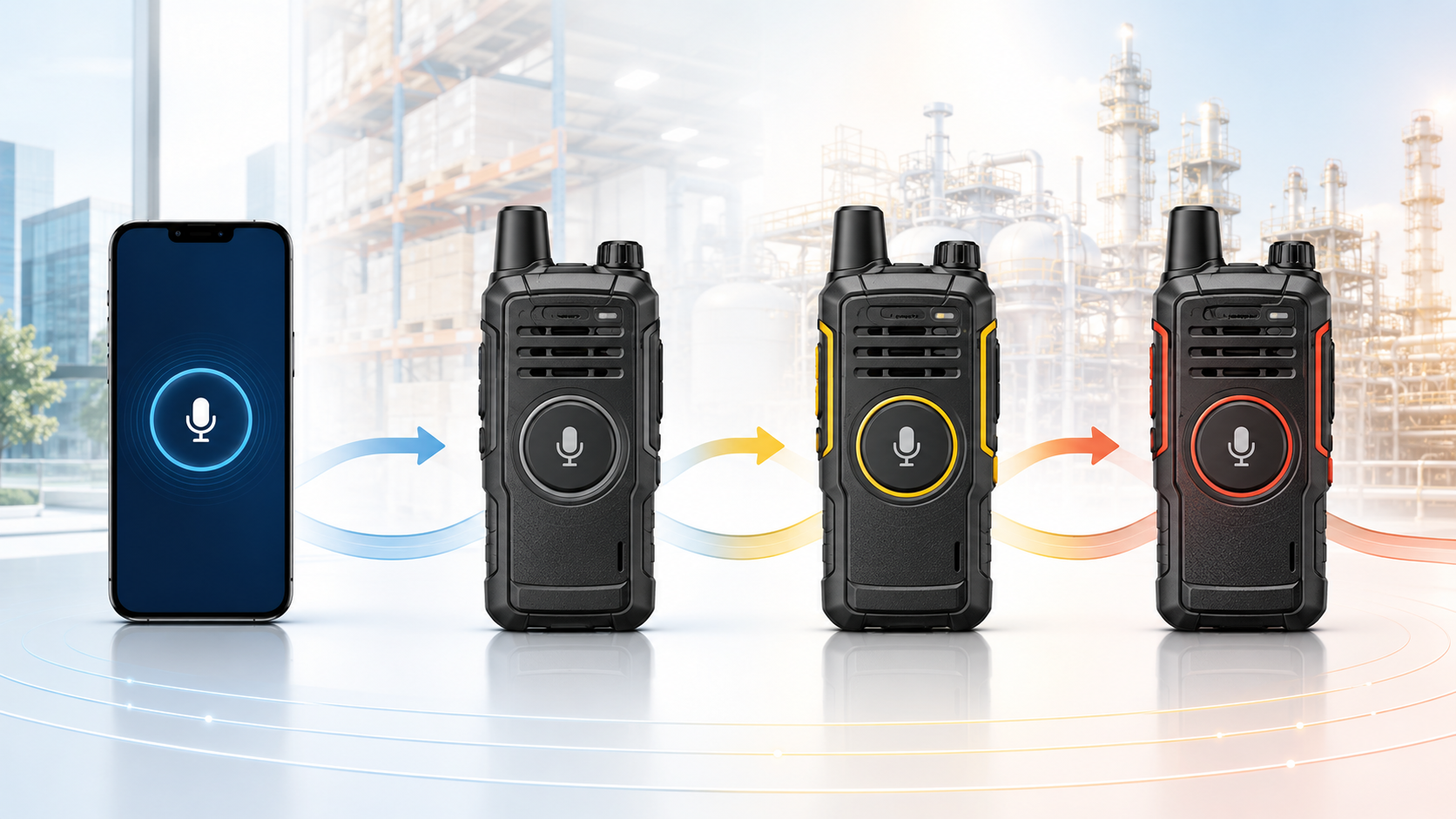
IS440.RG, IS440.2, or IS440.1 – what is actually the difference?
We hear this question often.
And at least with the IS440.1 and IS440.2 the answer is much simpler than many customers assume.
Both devices are based on practically the same technical platform and have, among other things, the same processor, the same memory size, the same dimensions, the same screen, the same communication interfaces, and the same operating concept. The crucial difference for the user lies in the approval for explosive environments.
| Device | Typical application area | Ex area |
|---|---|---|
| Normal smartphone | Office, service, logistics, field service | depending on the device used |
| IS440.RG | Industry and professional PTT applications without Ex requirements | no ATEX device |
| IS440.2 | PTT in explosion-prone areas | Zone 2/22 |
| IS440.1 | PTT in explosion-prone areas | Zone 1/21 |
i.safe MOBILE explicitly assigns the IS440.RG to industrial use, the IS440.2 to Zone 2/22, and the IS440.1 to Zone 1/21.
For the selection, this simplifies to:
No Ex area? IS440.RG.
Zone 2/22? IS440.2.
Zone 1/21? IS440.1.
So you don't have to think about which device is "better" for the IS440.1 and IS440.2.
The crucial question is:
In which zone should the device be used?
But is the IS440.x now a radio or a smartphone?
Actually, this question is less important than it initially appears.
The IS440 series combines the operation that many users know from classic radios with the technology of a modern Android-based communication device.
There is a large push-to-talk button, a channel selector switch, function keys, and a powerful speaker.
Voice transmission in a PoC application like Mobile Tornado, however, occurs over an IP network.
For the user, the operation therefore feels similar to that of a radio.
In the background, the technology is different.
Is this a "bridge" between classic radio and mobile communication?
Here, an important clarification is worthwhile.
In modern PoC devices, one often reads formulations that they form a "bridge between classic radio and modern mobile networks."
This can easily be misunderstood.
An IS440.x cannot simply communicate directly with an existing classic DMR, TETRA, VHF, or UHF radio.
If an existing radio infrastructure is to be connected to a PoC platform, a corresponding technical integration or a gateway is required.
i.safe MOBILE also explicitly describes interoperability with earlier radio technologies via a gateway. Mobile Tornado also offers options for integrating existing LMR systems such as DMR, TETRA, or P25.
The IS440.x itself is therefore not the bridge.
It is an end device.
The connection of different communication systems only arises through the additional infrastructure behind it.
Does Mobile Tornado therefore have to replace classic radios?
No.
And that should not be the goal of every implementation from our perspective.
There are applications where PoC offers enormous advantages – and there are applications where a classic radio system is still very sensible.
A good example is the communication between a spotter and a crane operator.
This is not about the colleague in Cologne being able to talk to the colleague in Hamburg.
This may be about seconds and clear instructions such as:
Stop.
Lift slowly.
To the left.
Set down.
When such communication has an immediate impact on a dangerous movement, we view it differently than normal operational communication.
The DGUV Regulation 52 requires that during crane operations, the crane operator only controls based on signals from a signal person when visibility is lacking. For manually attached loads, movements may only occur upon clear signals from the rigger, signal person, or another responsible individual; the signals used must be agreed upon in advance. The regulation does not specify a particular radio technology at this point.
Nevertheless, we derive a clear practical recommendation from this:
If a safety-critical movement directly depends on a single communication link, the communication solution should be specifically planned for this purpose and considered in the risk assessment.
A classic professional radio system can have advantages here.
In a local radio connection, communication can occur directly between the devices or via a radio infrastructure specifically designed for this purpose. A normal PoC application on a smartphone, on the other hand, is additionally dependent on factors such as mobile or Wi-Fi coverage, network availability, end device, and data connection.
Therefore, we would not simply say for the guidance of a crane:
"Take any smartphone with a PTT app."
For such safety-critical applications, a classic professional radio system may be the better and more manageable solution.
Does this mean that PoC is not suitable for critical communication?
No. That would also be too simple.
Mobile Tornado also offers solutions in the area of 3GPP Mission Critical Services (MCX) on. Such systems are designed for requirements that go far beyond a normal PTT app on any smartphone.
Therefore, the distinction is crucial:
"Push-to-Talk over an app in the public mobile network" is not automatically the same as a fully planned mission-critical communication solution.
Similarly, not every classic radio is automatically suitable for every safety-critical application.
What is always crucial are the use case, network supply, redundancy, devices, infrastructure, and risk assessment.
Where does Mobile Tornado showcase its strengths?
Mobile Tornado becomes particularly interesting when communication is not just to take place on a small factory site.
Typical examples include service and field service organizations, logistics companies, maintenance, plant communication, security services, or companies with multiple locations.
In addition to voice communication, the platform also supports group communication, messaging, and multimedia. Depending on the chosen solution, additional features such as location information, lone worker protection, device management, and workforce management may be added.
And above all, different device types can be used within a communication solution.
The sales representative can use his smartphone.
The employee in production uses an IS440.RG.
The employee in Zone 2/22 receives an IS440.2.
The employee in Zone 1/21 uses an IS440.1.
All use the same communication principle – but the end device fits the respective workplace.
PoC or classic radio? You don't have to choose one world.
From our perspective, this is the most important insight.
It's not about fundamentally replacing classic radio technology with mobile communications.
It's about using the appropriate communication for each specific task.
A simple orientation:
Communication over long distances, multiple locations, and different devices: PoC like Mobile Tornado showcases its strengths.
Immediate safety-critical instructions in a clearly defined work area: A classic radio system specifically designed for this purpose may be the better choice.
Companies with both requirements: Both systems can be operated in parallel and connected to each other via suitable infrastructure if needed.
This is not a weakness of PoC.
On the contrary: It prevents the attempt to solve every communication problem with a single technical system.
The entry can still be very simple.
Anyone who wants to get to know Mobile Tornado does not need to start a large infrastructure project.
A compatible smartphone is sufficient for the entry.
Install the app, set up users, define groups – and communication can begin.
If it subsequently becomes clear that certain employees need better PTT operation, professional devices can be added.
For the non-ATEX industrial sector, for example, the IS440.RG.
For Zone 2/22 the IS440.2.
For Zone 1/21 the IS440.1.
Other devices specifically developed for professional communication can complement the portfolio.
Mobile Tornado at ATEXshop.de
At ATEXshop.de, you can get Mobile Tornado both as a software solution for suitable existing devices and together with professional hardware.
In doing so, we do not simply want to sell you as many devices as possible.
We want to know first:
Who should communicate with whom?
Where are the employees located?
Are there explosion hazard areas?
What Ex-zone is present?
And especially important:
Is it normal operational communication or does the safety of a work process directly depend on this communication?
Only then can it be sensibly decided whether an existing smartphone is sufficient, whether a professional PoC device like the IS440.x makes sense, or whether a classic radio system remains the better solution for a specific work process.
Our conclusion
Mobile Tornado makes professional push-to-talk communication surprisingly easy.
You do not automatically need a special radio device.
For many applications, an existing smartphone is initially sufficient.
Those who prefer the operation of a professional radio device can switch to specially developed PTT devices.
And if ATEX is required, the device is selected according to the existing Ex-zone.
IS440.RG for the non-ATEX area.
IS440.2 for Zone 2/22.
IS440.1 for Zone 1/21.
Mobile Tornado is therefore not a blanket replacement for traditional radio technology.
It is an additional communication platform that becomes particularly interesting where employees, locations, and different devices need to be easily connected.
And sometimes the best communication solution is simply not PoC or radio, but:
PoC where PoC has its advantages – and traditional radio where traditional radio has its advantages.